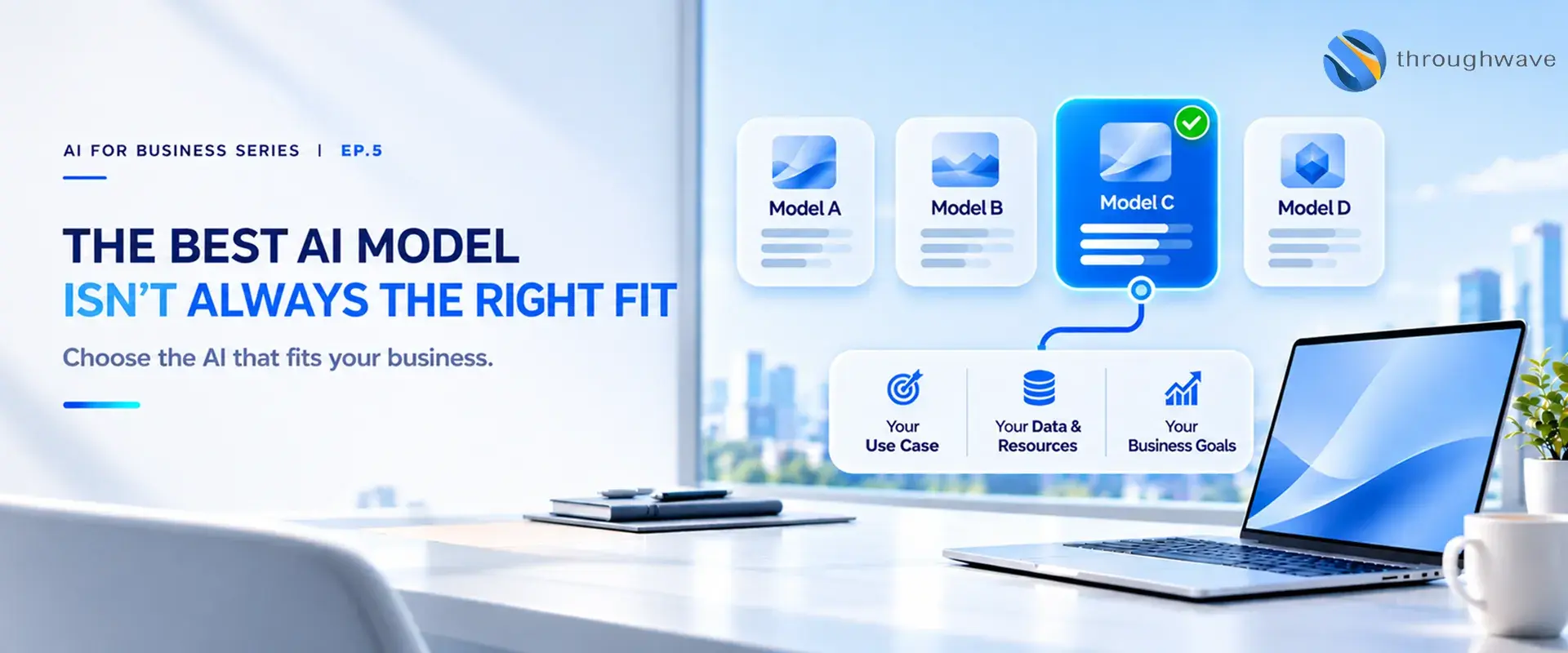
AI for Business Series | EP.5 — Choosing the Right AI: Why the “Best” Model May Not Be the Best Fit for Your Business
Beyond Benchmark Scores: Choosing AI That Meets Business Needs
In the first four episodes, we explored the importance of data ecosystems (EP.1–2), system architecture (EP.3), and balancing security with intelligence (EP.4). As we reach the final episode, many organizations may be asking an important question:
“So, which AI model should we choose? Does it have to be the most expensive model, or the one with the highest benchmark score?”
In enterprise AI, there is no “one size fits all.” Choosing AI is not about finding the most capable model in the world. It is about finding the model that is best suited to the task, the data, and the organization’s resource constraints.
1. Start with the Use Case, Not the Model Name
Different departments have significantly different needs:
- Human Resources (HR): Needs reliable retrieval of relevant information and strong privacy protections.
- Customer Service: Needs fast response times (low latency) and a friendly tone.
- IT and Software Development: Needs logical reasoning and coding expertise.
AI capabilities come at different costs. Using an expensive, large model for basic tasks can therefore lead to inefficient spending.
2. Benchmarks Are a Compass, Not the Final Answer
Public benchmark scores can help create an initial shortlist. But models must ultimately be evaluated through in-house testing against the organization’s actual tasks and requirements:
- How well does the AI understand Thai and your business-specific context?
- When connected to RAG, can the full system retrieve relevant information and produce accurate summaries from your technical manuals?
- Is its response time acceptable to employees or customers?
Organizations should build their own custom evaluation set to compare models and the systems built around them in a real-world environment (EP.3).
3. Multi-Model Strategy and Model Routing
Modern organizations do not need to rely on a single model. They can design an architecture that selects models based on the complexity of each task:
- Simple or repetitive tasks: Use smaller language models (Small Language Models) that may offer faster responses and lower costs.
- Complex tasks that require deeper analysis: Route them to larger models (Large Language Models), if testing shows they perform better for those tasks.
- Specialized tasks: Use fine-tuned models or models designed specifically for images or audio (EP.1).
This approach can help manage total cost of ownership (TCO) more effectively, provided the routing strategy is evaluated against the organization’s own workload.
4. The Lasting Assets: What Remains When You Change Models
The AI market is moving quickly. The most capable model today may be outdated in six months. A sound AI strategy should therefore focus on building proprietary digital assets that can be used with different models in the future:
| What Can Change (Commodities) | Lasting Strategic Assets |
|---|---|
| AI models (LLMs / foundation models) | Clean, structured data |
| Cloud or API providers | Knowledge labeled by subject matter experts |
| Current hardware and GPU models | Specialized evaluation sets and measurement criteria |
| Tools and frameworks | The organization’s security and governance standards |
Organizations that adopt a model-agnostic architecture—one that is not tied to a specific model—can retain more flexibility to adopt other technologies, subject to compatibility, evaluation, and governance requirements.
5. The Path to Becoming an AI-Driven Organization
Getting real impact from AI is not just a technology challenge. It also requires effective change management:
- Workflow Integration: Rather than creating a standalone chatbot, embed AI into real business processes (Embedded AI).
- AI Champions: Appoint representatives in each department who understand both the work and the tools, and can identify new opportunities.
- Responsible AI Governance: Set clear usage policies to reduce the risks of Shadow AI—AI used outside the organization’s controls—and manage information security risks.
- Human-in-the-Loop: Keep people involved in reviewing and approving AI outputs, especially in high-risk tasks.
Seven Questions Before Starting Your AI Strategy
- Objective: What problem are we trying to solve, and how will we measure success?
- Data Readiness: Is our data ready, secure, and of sufficient quality for AI?
- Role of AI: Will AI act as an assistant, a co-pilot, or an automated system?
- Key Priorities: What matters most for this use case: quality, speed, cost, or privacy?
- Evaluation: How will we prove that this AI performs better than our current approach?
- Scalability: What will the costs and risks look like when we expand AI use across the organization?
- Sovereignty: How much control and flexibility will we retain over our data, infrastructure, and technology choices as our needs change?
Series Conclusion: AI Creates Value When It Understands Your Business
Across all five episodes of the AI for Business Series, we have seen that business success with AI does not come from owning the most expensive technology. It comes from:
- Understanding your data context
- Building a flexible and secure system architecture
- Measuring results against real-world requirements
- Empowering people to use AI wisely
In the AI era, competitive advantage does not come from being the first to use the latest model. It comes from turning an organization’s knowledge into a digital asset that AI can use effectively.
Throughwave is committed to supporting your journey into the world of AI. From identifying worthwhile use cases and preparing your data foundation to designing Private AI & RAG architectures and developing specialized custom models, we help your business move beyond its current limits with AI that is truly the right fit.
Don’t start by asking, “Which AI should we use?”
Start by telling us, “Where do you want your business to go?” Then we’ll work with you to find the answer.
Related Articles

AI for Business Series | EP.4 — Private AI and RAG: Two Complementary Technologies for a Secure, Intelligent Enterprise
11/9/2026
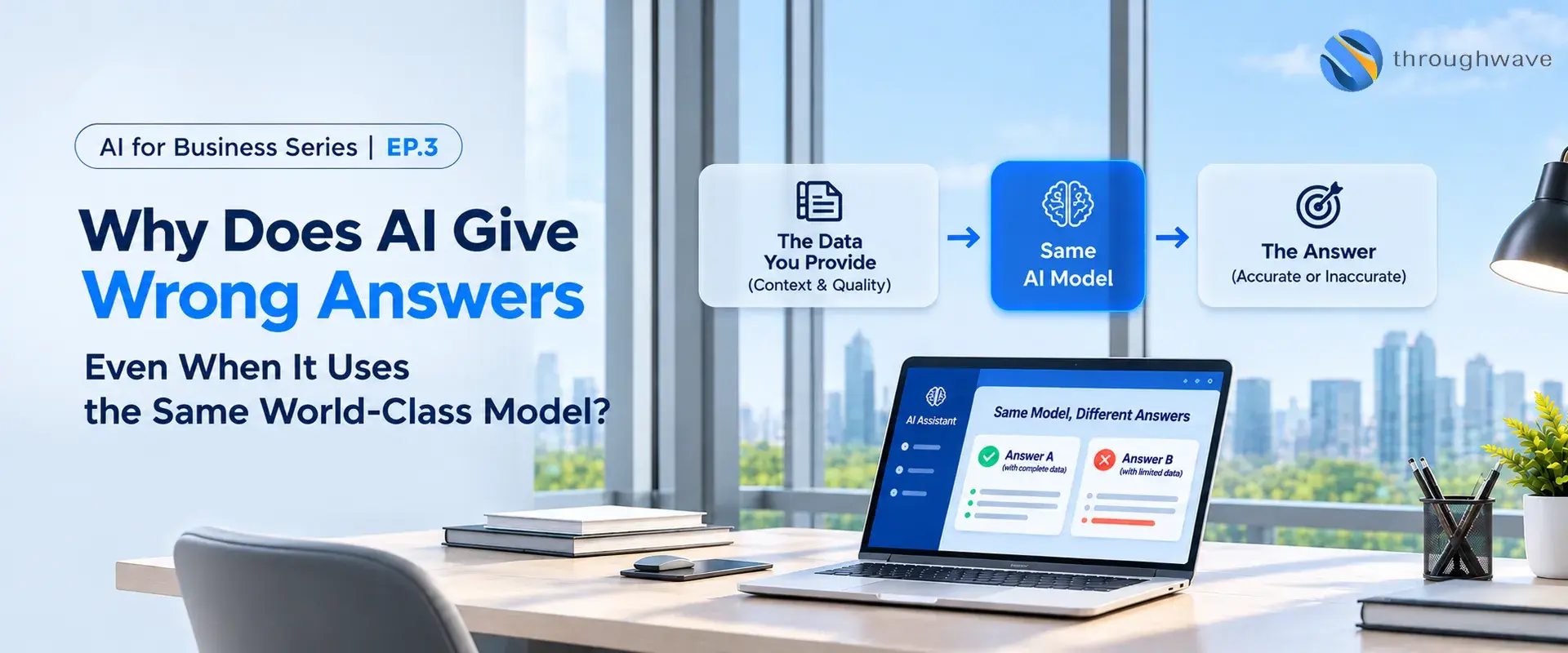
AI for Business Series | EP.3 — Why Does AI Give Wrong Answers Even When It Uses the Same World-Class Model?
11/2/2026
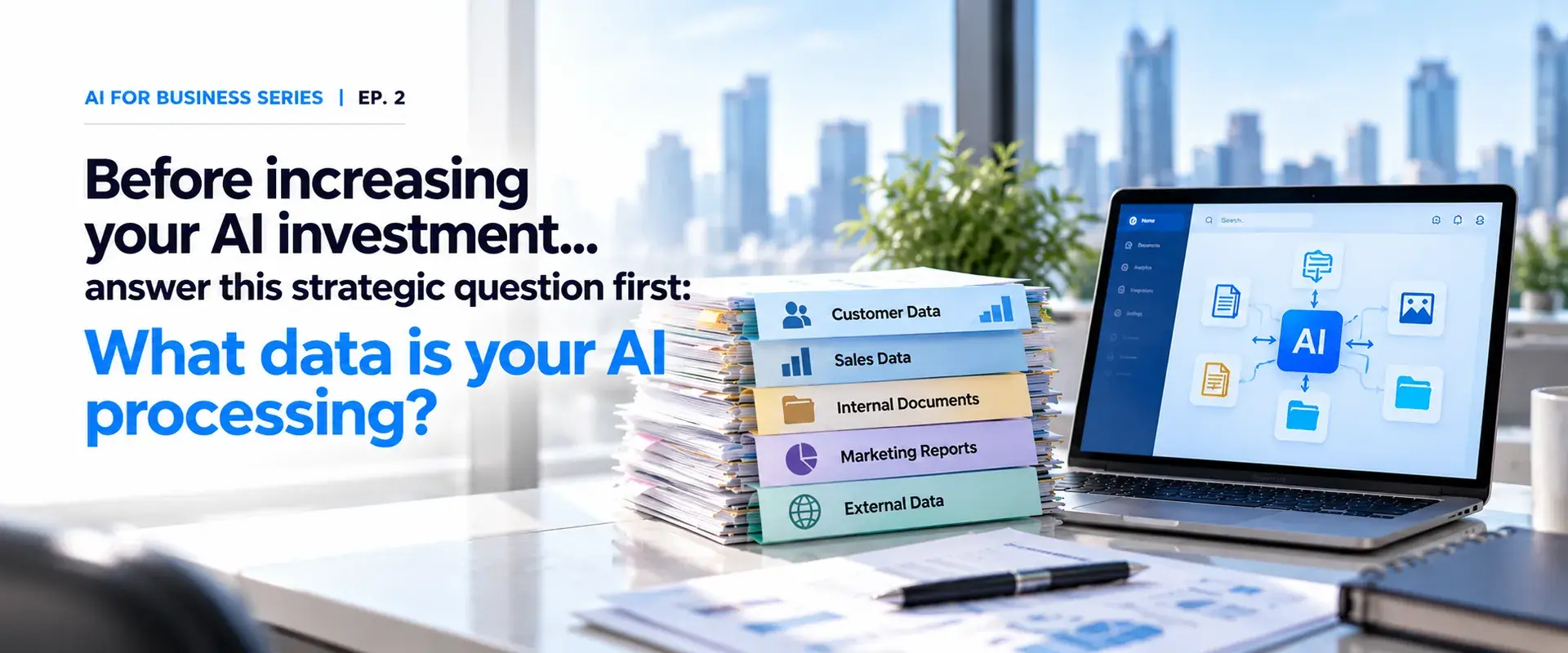
AI for Business Series | EP.2 — Before Increasing Your AI Investment, Answer This Strategic Question: What Data Is Your AI Processing?
10/28/2026