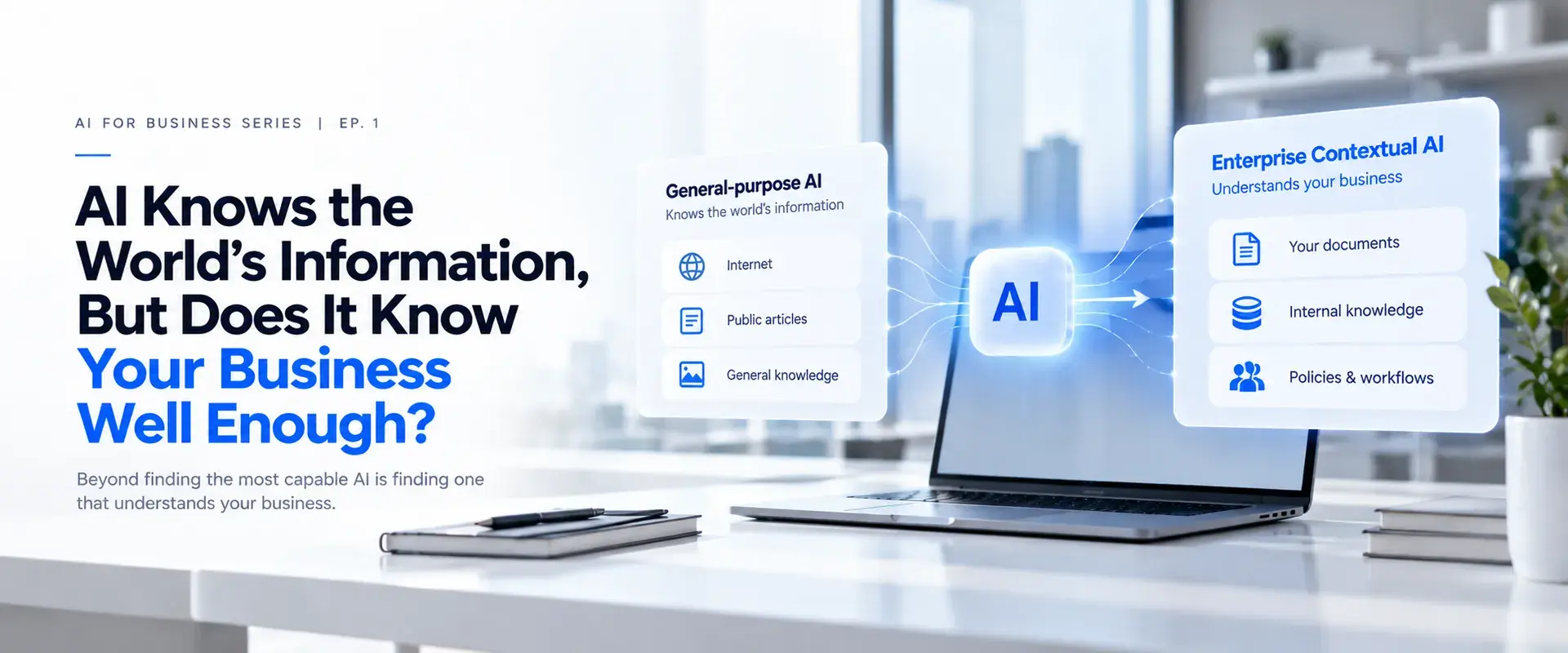
AI for Business Series | EP.1 — AI Knows the World’s Information, But Does It Know Your Business Well Enough?
Beyond Finding the Most Capable AI Is Finding One That Understands Your Business
Generative AI has become an important tool for organizations. It can answer questions, summarize documents, and improve day-to-day productivity. As a result, many companies are focused on finding the largest models or the most advanced technologies.
But before asking, “Which AI is the best?”, there is a more important strategic question:
“Can that AI access and understand the knowledge that is unique to our business?”
No matter how capable the AI models on the market may be, they do not inherently know your internal policies, standard operating procedures (SOPs), specialized product knowledge, pricing structures, or workflows—the intellectual assets that are essential to your organization.
- AI may understand sales theory, but not know your company’s approval requirements for special discounts.
- AI may know about human resources, but not know your latest leave policy.
- AI may offer general IT troubleshooting advice, but not know the procedures specific to your company’s infrastructure.
This is the key difference between general-purpose AI, which answers from general knowledge, and enterprise contextual AI, which uses an organization’s own data as the basis for its responses.
Much of a Business’s Valuable Knowledge Is Hidden in “Invisible Data”
Knowledge accumulated over many years—SOPs, customer service manuals, approval matrices, and compliance documents—is often not available on the internet for general-purpose AI systems to access.
The challenge is that this information is usually scattered across multiple systems, such as SharePoint, file servers, Google Drive, and internal document management systems (DMS). It can be further complicated by multiple versions of the same document, leaving employees unsure which file is the latest version currently in effect.
Imagine an employee asks:
“If a customer requests an 18% discount, who needs to approve it?”
General-purpose AI may offer advice based on common business practices, but it cannot identify the correct approval matrix under your company’s rules if it cannot access the right reference sources.
If the AI system is connected to the official pricing policy and approval matrix, it can retrieve relevant information and use it as context to generate a more accurate answer. It can also cite the source documents so employees can verify the information with confidence.
In the world of Enterprise AI, “being able to answer” is not the same as “answering accurately based on an organization’s actual information.”
Transforming How Organizations Use Data with RAG
Retrieval-Augmented Generation (RAG) is an architecture that helps bridge this gap. It retrieves relevant information from sources designated by the organization and adds it as context for the AI model when generating a response. This means the model does not have to rely solely on its general knowledge.
For example, when someone asks about sales terms, the system can search the company’s knowledge base—such as its pricing policy or product manual—and provide the most relevant information as a reference for the model.
However, RAG is not a formula that automatically guarantees 100% accuracy. Its performance still depends on several important factors:
- Data Quality: Source information must be clean and up to date.
- Retrieval Precision: The system must find information that is relevant to the question.
- Access Control & Governance: Data access must be governed by appropriate permissions and policies.
Protecting Business Data with Private AI
RAG and Private AI complement each other, but they have different focuses.
RAG focuses on retrieving information for the AI to use. Private AI focuses on the environment in which AI operates and the level of control an organization has over it. Organizations that handle sensitive information—such as customer data, intellectual property (IP), or financial data—need robust security, privacy, and governance controls.
Enterprise AI systems must also work with identity and access control systems to ensure that information reaches only authorized users. For example, sales employees may be able to access pricing information, while detailed financial data is reserved for executives or the relevant departments.
Enterprise AI Goes Beyond Text
Business data is not limited to text documents. It also includes:
- Audio: Call center recordings containing specialized terminology or regional accents
- Vision: Production line images used for defect detection
- Video: CCTV footage used to monitor safety or customer behavior
- IoT & Sensors: Signals from machinery used to predict potential failures through predictive maintenance
These data types are not always well suited to conventional RAG alone. And for specialized tasks, off-the-shelf models may not be accurate enough. For example, a general speech recognition model may misspell a company’s product names, while a general image recognition model may not know which marks count as defects under a factory’s quality control (QC) standards.
When Off-the-Shelf Models Fall Short: Custom Models
For tasks that require high precision, organizations may need to consider more specialized approaches:
- Fine-tuning: Adapting a foundation model with organization-specific data—for example, teaching it specialized technical terminology.
- Custom models: Developing neural networks for specific tasks, such as computer vision for QC or time-series models for sensor data analysis.
- Traditional machine learning: For some numerical or tabular analysis tasks, smaller conventional models may deliver faster, more accurate results while using fewer resources than a large LLM.
Combining Specialized Models and LLMs
The most effective Enterprise AI systems often combine multiple models through multi-model orchestration:
1. Specialized models transform raw data—such as audio or images—into usable, structured data.
2. LLMs and RAG connect that information with organizational knowledge and present results that support human decision-making.
For example, in a call center, a speech model transcribes a conversation → the system indexes the information → an LLM uses RAG to summarize key points and assess whether the employee followed the customer service guidelines.
Six Strategic Questions to Ask Before Applying AI to Business Data
- Knowledge Source: Is the AI answering from general knowledge or from an official organizational source?
- Data Currency: Is the information it uses the latest version currently in effect?
- Traceability: Can users verify the source of an answer?
- Authorization: How does the system enforce access permissions based on each user’s role?
- Risk Management: Do high-risk tasks include human review or a human-in-the-loop process?
- Technology Alignment: Does the problem really require an LLM, or would a more suitable specialized model work better?
Conclusion
Ultimately, AI that creates real business value does not need to know everything. It needs to apply an organization’s knowledge accurately and securely, under clear governance.
Follow the next installment of AI for Business Series | EP.2
Before investing more in AI, answer this question first: What is your AI using to generate its answers?
If your organization is exploring how to apply AI to internal data, Throughwave can provide end-to-end guidance—from assessing AI readiness and designing data and AI architecture to developing specialized custom models. We help organizations build AI systems around their business goals, supported by security and governance practices aligned with international standards.


