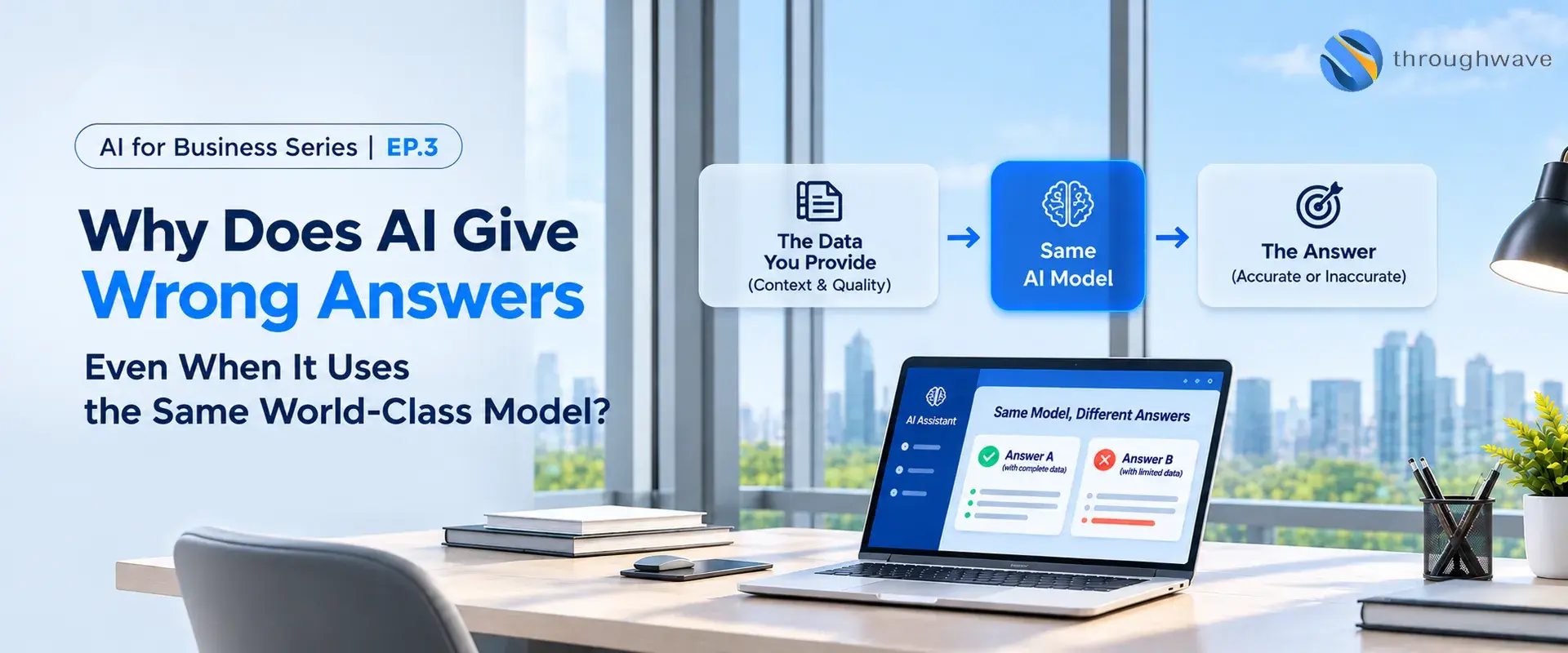
AI for Business Series | EP.3 — Why Does AI Give Wrong Answers Even When It Uses the Same World-Class Model?
When the Same Model Doesn’t Guarantee the Same Results
In EP.1 and EP.2, we explored the importance of connecting AI to business data and removing bottlenecks from the data ecosystem. But when organizations move AI into production, one question often causes confusion:
“Why do systems using the same AI model deliver different levels of accuracy?”
An AI’s answer is determined by more than the model’s name. It is shaped by the entire system architecture: its context, prompts, retrieval process, configuration, and the quality of its reference data.
So when AI gives an inaccurate answer, the strategic question shouldn’t be limited to “Which model are we using?” We also need to ask: “What data and context does the system provide to the model before it generates an answer?”
Same Model ≠ Same AI System: It Comes Down to Context
Imagine two employees are asked the same question: “Is this product eligible for on-site service?”
- Employee one has the latest product manual and the service policy that applies to the customer’s category.
- Employee two has an outdated product manual and no service policy.
Even if both employees have similar capabilities, their answers could be entirely different because they are making decisions based on different information.
The same is true for AI. If the retrieval system fails to find all the relevant documents or ranks the context incorrectly, the model receives incomplete or inaccurate information from the start.
The key point is this: what you use in practice is not just a “model,” but an entire “AI system” working together.
Behind the Scenes: What Happens Before an Answer Is Generated?
In an enterprise AI system built on a RAG architecture, the process often looks like this:
User Question → Query Processing → Retrieval → Context Construction → Prompt Engineering → Model Processing → Final Answer
Errors can occur at every stage:
- Retrieval Failure: If the system can’t find important information, the answer will be based on incomplete data.
- Context Overload: If the model receives too much irrelevant or conflicting information, it may become confused and select the wrong details.
- Prompt Constraints: If the instructions aren’t clear or strict enough—for example, if they don’t tell the AI to use only company information—the AI may mix in general knowledge and produce false information.
The “Cascading Errors” Effect
For organizations working with different types of data, such as audio, images, and video, the data journey becomes longer—and errors can compound more easily:
- Speech-to-text error: A product name or model number is transcribed incorrectly.
- Retrieval error: The system then finds the manual for the wrong product.
- LLM summarization error: The AI generates a convincing answer, but it describes a different product.
This is why the same LLM can produce dramatically different results in two different systems.
The Same Architecture, Trained Differently: Custom Models
The phrase “same model” requires even more care when discussing custom or fine-tuned models. Models built on the same base model can behave very differently if they were trained on different data, particularly in terms of:
- Data Purity: How clean the data is and how consistently it is labeled.
- Diversity: How well the data covers real-world scenarios.
- Training–Serving Skew: The difference between the training environment and the production environment—for example, training on high-quality audio but deploying in a noisy phone system.
When the World Changes but AI Stays the Same: Data Drift
Even if you don’t change the system, answer quality can decline over time as real-world data changes. Policies are updated, new products are introduced, and customer behavior shifts.
If the RAG knowledge base isn’t updated or a specialized model isn’t retrained with new data, system performance will inevitably deteriorate.
How to Investigate Wrong Answers: Don’t Blame the Model First
When AI gives an inaccurate answer, investigate the system layer by layer to find the real cause:
| Problem area | Symptoms | Recommended action |
|---|---|---|
| Input / Perception | Speech is transcribed incorrectly or text is misread at the input stage | Improve the upstream model, such as speech recognition or vision |
| Retrieval | Relevant documents aren’t found, or irrelevant ones are returned | Improve the search algorithm and indexing |
| Context & Knowledge | Outdated or conflicting documents are used | Improve data governance and version control |
| Prompt Engineering | The AI uses the wrong format or mixes in general knowledge | Improve the instructions and prompt structure |
| Model Capability | The context is good, but the AI still reaches the wrong conclusion | Consider upgrading or switching to a more suitable model |
Separating the causes this way helps organizations fix the right problem, save costs, and avoid unnecessary investment in a model that may not be the source of the issue.
Turn Mistakes into Opportunities: Regression Testing
Every wrong answer is a valuable data point. By analyzing these cases, having experts label the correct answers, and adding them to a test set, organizations can gradually build a stronger suite of tests. It can be used for regression testing whenever the system changes, helping ensure that fixing one problem doesn’t create another elsewhere.
Seven Questions for IT Teams and Executives as AI Moves into Production
1. Observability: When an answer is inaccurate, can we quickly identify which step failed?
2. Traceability: Can the system show which documents it retrieved and used as sources?
3. Versioning: Do we know which model version, prompt version, and knowledge base produced this answer?
4. Evaluation Framework: Do we have a test set, separate from training data, for objective performance measurement?
5. Drift Monitoring: Do we continuously monitor system performance as it encounters new data?
6. Human-in-the-loop: For high-risk tasks, is there an appropriate human review process?
7. Continuous Improvement: How do we use real-world feedback to improve our data and models?
The goal of enterprise AI isn’t to guarantee 100% accuracy at all times—that’s difficult to achieve. The goal is to build a system that can “be monitored, analyzed, and improved systematically” when mistakes happen.
Follow the AI for Business Series | EP.4: How Are Private AI and RAG Different?
If your organization is dealing with inconsistent AI answers or wants to establish a reliable evaluation framework, Throughwave is ready to advise on designing an AI architecture that is transparent, auditable, and effective for your business needs.
Related Articles
AI for Business Series | EP.2 — Before Increasing Your AI Investment, Answer This Strategic Question: What Data Is Your AI Processing?
10/28/2026

AI for Business Series | EP.1 — AI Knows the World’s Information, But Does It Know Your Business Well Enough?
10/20/2026

The Ultimate Liquid-Cooled Local AI Supercomputer for AI Natives
6/20/2026